All posts by calendarMan

Comparative Drama Conference 2026 – Edward Albee Society

The Edward Albee Society will sponsor two sessions at the 2026 Comparative Drama Conference at the University of Wisconsin-Madison, July 9-11. The session titles are “Roundtable: Publications and Conference in Celebration of Edward Albee’s Centenary in 2028” (in person) and “Albee in Comparison: Transnational Contexts and Continuities” (virtual).

1) Roundtable: Publications and Conference in Celebration of Edward Albee’s Centenary in 2028

Timeline:

Michael Y. Bennett (University of Wisconsin-Whitewater) will discuss two major publications he is editing for the Centenary. 10 minutes

David A. Crespy (University of Missouri-Columbia) will discuss his Albee biography focusing on the third act of Albee’s career and life. 10 minutes

Lincoln Konkle (The College of New Jersey) will discuss EAS’s preliminary plans for a three-day academic conference to be held in New York City, March 10-12, 2028. 10 minutes

Toby Zinman (University of the Arts) will discuss the topic of one session we are planning for the centenary conference: Albee and Art. 10 minutes

Questions and Answers: 20 minutes

2) Albee in Comparison: Transnational Contexts and Continuities

This panel explores Edward Albee’s plays in transnational perspective, examining how his dramaturgy resonates with, contrasts, and dialogues with playwrights from diverse cultural and sociopolitical contexts. It highlights continuities, adaptations, and critical exchanges that have shaped modern and contemporary theater across the 20th century.

Abstracts:

Gaining Loss: Resonances of Edward Albee’s Poetics of Assault in Leilah Assumpção’s Theater
Dr. Esther Marinho Santana, University of São Paulo

In 1969, Brazil entered the darkest phase of the civil-military dictatorship initiated five years earlier. As institutional censorship intensified and dissent was violently suppressed, the theatrical scene paradoxically experienced a surge of creativity with the emergence of the so-called “1969 Generation”, a cohort of young playwrights debuting in Rio de Janeiro and São Paulo. Among them was Leilah Assumpção, whose work exemplifies the group’s shared characteristics: short, tense plays centered on two antagonist characters, immersed in turbulent encounters culminating in sudden aggression. Among the factors contributing to their dramaturgical convergence was the fruitful career of Edward Albee’s The Zoo Story on Brazilian stages throughout the 1960s (Santana, 2020).
This paper examines the resonances between Albee’s 1959 one-act play and Assumpção’s Fala baixo, senão eu grito (Keep Your Voice Down or I’ll Scream). An analysis of intertextual echoes reveals how Assumpção’s dramaturgy absorbs and adapts the tensions of Albee’s work – and what I term its poetics of assault – to articulate its own aesthetics of metatheatrical confrontation and salvific provocation. This study thus argues that, although produced in markedly different contexts, both plays mobilize aggression as a performative gesture of rupture and redemption, ultimately positioning destruction as an ambivalent yet potentially transcendent pathway to individual liberation.

Voices That Fracture the Real: Edward Albee and Sevim Burak in a Transnational Dialogue
Dr. Mehmet Zeki Giritli, Koç University-Istanbul

This paper places Edward Albee’s Who’s Afraid of Virginia Woolf in conversation with Turkish playwright Sevim Burak’s Sahibinin Sesi (His Master’s Voice) and explores how modernist theatre challenges realist conventions across distinct cultural and historical contexts. Sevim Burak (1931-1983) is regarded as one of the most radical and innovative figures in modern Turkish literature and theatre. Her dramaturgy breaks away from conventional dramatic structure, psychological realism, and linear narrative, embracing fragmented voices, shifting identities, and non-mimetic forms. While Albee tears down the psychological realism of the American domestic sphere, Burak disrupts narrative coherence in post-imperial Istanbul. Both playwrights highlight language as a site of disintegration, a means of uncommunication and instability, and challenge the limits of realist representation through fractured dialogue, unstable identities, and violence embedded in everyday speech. Through a close reading of both plays, this paper argues that Burak’s radical theatricality reveals a non-Western experimental dramaturgy that resonates with, yet challenges Albee’s aesthetics.

Domestic Conflict and Cultural Mediation: Albee’s Who’s Afraid of Virginia Woolf? and Paso’s Un matrimonio muy muy muy feliz
Vicente Chacón-Carmona, University of Seville

This paper examines the parallels between Edward Albee’s Who’s Afraid of Virginia Woolf? (1962) and Alfonso Paso’s Un matrimonio muy muy muy feliz (1968). Both dramatists stage the domestic sphere as a site of psychological violence, illusion, and emotional exhaustion, yet they do so under profoundly different social and aesthetic regimes. While Albee’s play dissects the American dream through linguistic cruelty and the exposure of marital fictions, Paso’s comedy transforms similar conflicts into bourgeois farce, where excess emotion is defused by irony and humor. Written under Franco’s censorship, Un matrimonio muy muy muy feliz reframes marital despair within the boundaries of moral respectability, converting existential trauma into satire.
By comparing dialogue patterns, character dynamics, and tonal shifts, this paper explores how Albee’s modernist tension becomes Paso’s domestic containment, revealing the transnational migration of dramatic motifs across ideological borders. The study contends that Paso’s play, rather than imitating Albee, offers a localized rearticulation of the same anxieties about truth, performance, and emotional authenticity within the Spanish cultural climate of the late 1960s.

Ageing In Time: Harold Pinter’s Landscape (1969) and Edward Albee’s Listening (1976)
Antonia Tsamouris, ‘Deree’-The American College of Greece

According to the theory of Phenomenology and Maurice Merleau-Ponty, “all our experiences, inasmuch as they are ours, arrange themselves in terms of before and after” (476). The philosopher highlights the importance of subjectivity, for every human being, in relation to time. Nonetheless, temporality poses the question of ageing, as one’s misconception of the older self may lead towards a “méconnaissance” of the present one. As Leni Marshall wonders, people, in the course of time, often feel estranged from the image of their past self. Marshall argues on the role of temporality in ageing, as the humane body becomes a site indicating the passing of time, while memory plays crucial role.
This paper will examine time, temporality and the importance of bodily spatiality in ageing, by comparing and analysing two plays, written only a few years apart, by Harold Pinter and Edward Albee, respectively.
The Nobel Prize writer, Harold Pinter, depicted with his playwriting his immense interest in time. In his “Memory plays”, written during this period, Pinter highlights his preoccupation with memory, ageing, space and temporality. In Landscape (1968) Pinter placed a man and a woman in a timeless setting, talking about the past and the present. Some years later, Edward Albee wrote Listening (1976), in which a middle-aged man and a woman, and a younger woman, discuss memory, subjectivity and time. Both plays, first presented on radio, focus on the perception of time, as a cognitive procedure, though indissoluble linked to the subject’s image. As Merleau-Ponty underlines, “to analyse time” one needs to “gain access, through time, to [the] concrete structure” of the subject, which entails its image, as the “idea of the subject” (477).

For more details about the 2026 Comparative Drama Conference, please visit the University of Wisconsin-Madison website.
Comparative Drama Conference 2026 Logo

Back to News

Call for Submissions: “The Routledge Studies in Edward Albee and American Theatre” Invites Book Proposals and/or Articles

Routledge LogoThe Edward Albee Society is proud to announce the launch of The Routledge Studies in Edward Albee and American Theatre and sends out this call for proposals for new projects.
The new book series aims to examine mid-to-late 20th Century American theatre; its most influential and important playwright, Edward Albee; and his contemporaries.

This series is equally dedicated to both dramatic literature and theatrical performance, thinking about the American theatre in its totality. This series wants to examine the milieu of American theatre during the course of Albee’s six-decade-long career. Additionally, Edward Albee was a great champion of supporting other playwrights; therefore, in keeping with the mission of the Edward Albee Society, this series is especially interested in books about playwrights that were influenced by Albee.

In addition to monographs and edited collections that fall under the above purview, there will also be a sub-series of edited books that looks at a specific decade of American theatre through the lens of Albee and his milieu (e.g., Edward Albee and the American Theatre in the 1960s or Edward Albee and the American Theatre in the 1990s, etc.).

The following are examples of texts that could be included in the Edward Albee series:

  • A volume that highlights disability and performance in modern and contemporary American theatre.
  • An edited anthology of Edward Albee and the American Theatre of the 1950s
  • A monograph exploring Adrienne Kennedy’s work and the Black Arts Movement.

We welcome proposals that expand our perspectives and that of the field and look forward to reading your submissions. Please do check out the book series page on the official Routledge website.

We encourage your feedback and thoughts on the series. For more information or to send your proposal, please contact Michael Y. Bennett (Series editor) with inquiries bennettm@uww.edu or Laura Hussey at Routledge: laura.hussey@informa.com.

Series Editors: Michael Y. Bennett (University of Wisconsin-Whitewater); Laura Hussey (Routledge)

Advisory Board: Linda Ben-Zvi (Tel Aviv University), Natka Bianchini (Loyola University Maryland), Stephen Bottoms (University of Manchester), John M. Clum (Duke University), David A. Crespy (University of Missouri), Norma Jenckes (University of Cincinnati), Lincoln Konkle (The College of New Jersey), Brenda Murphy (University of Connecticut), Matthew Roudané (Georgia State University), and Rakesh H. Solomon (Indiana University)

Back to News

Volume 5 of “New Perspectives in Edward Albee Studies” Published

New Perspectives in Edward Albee Studies Cover

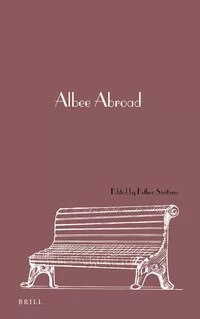
The cover for Albee Abroad
(Photo by Brill)

Brill has published the fifth and final volume of “New Perspectives in Edward Albee Studies,” Albee Abroad edited by Esther Santana! Visit the Brill website for complete details.

The final volume of the New Perspectives in Edward Albee Studies series expands the analyses of Edward Albee’s theatre beyond Anglophone countries. Ranging from academic essays, performance reviews, and interviews, the selected contributions examine different socio-political contexts, cultural dynamics, linguistic communities, and aesthetic traditions, from the 1960s to our contemporary days. Albee Abroad gladly brings together varied voices from Czech Republic, People’s Republic of China, Brazil, Iran, Germany, Spain, and Greece, thus enriching Albee scholarship with more plural tones.

The table of contents includes:

Introduction
Albee around the World
Author: Michael Y. Bennett

Chapter 1 “A Constant Struggle for Freedom: Edward Albee in Czechoslovakia and the Czech Republic”
Author: Tomáš Kačer

Chapter 2 “I’m Not There: Toward Albee’s Reception in China”
Author: Eddie Hanchen Feng

Chapter 3 “A Volcanic Contribution: The Zoo Story and the 1960s Brazilian Stages”
Author: Esther Santana

Chapter 4 “Edward Albee on Iranian Stages: A Critical Ethnography”
Authors: Mohammadali (Al) Dabiri and Deniz Khateri

Chapter 5 “American Absurdism as Philosophy: Edward Albee in Germany”
Author: Philipp Reisner

Chapter 6 “The Communication Paradigm in Recent German Albee Scholarship: A Review Essay”
Author: Philipp Reisner

Chapter 7 “Edward Albee’s 21st Century Spanish Canon: Bringing It Up to Speed or Honoring the Tradition?”
Author: Ramón Espejo Romero

Chapter 8 “Albee’s Greek Legacy in The Goat or, Who Is Sylvia?”
Author: Antonia Tsamouris

Chapter 9 “Interview: Philip Arnoult on Albee’s International Leadership”
Author: Natka Bianchini

Thanks to our series editor, Michael Y. Bennett, and our associate editor, Maija Birenbaum!

For more information about “New Perspectives in Edward Albee Studies,” visit our Book Series page.

Back to News

Staged Reading Series of Edward Albee’s Plays

The Edward Albee Society is excited to share the announcement of an opportunity to hear Albee’s plays, both famous and little‑known, read at The Black Box Performing Arts Center in Englewood, New Jersey, in association with The Estate of Edward Albee, as part of an ongoing, free monthly series: EDWARD ALBEE: FROM A TO ZOO, An Exclusive Staged Reading Series of Edward Albee’s Plays.

First up on Wednesday, May 24th at 7:30 PM: The Sandbox and The American Dream.

Performances will be followed by a conversation with the cast, director, and Jakob Holder, Executive Director of The Edward F. Albee Foundation. For updates on other readings, check the Black Box’s series webpage.

Back to News

Scholarly Article: Tiny Alice added to Works

Our website’s Works area continues to grow! Celine Rafferty has contributed a plot summary and critical analysis for Albee’s play, Tiny Alice.

Visit the Tiny Alice page in our Works area to enjoy all of these materials.

We would like to thank Ms. Rafferty for her contributions.

The Edward Albee Society’s Works web page is an ongoing project that catalogs the legacy and expands the scholarship of Edward Albee’s works. The page contains plot summaries, critical analyses, additional commentary, select bibliography, and overviews of collected editions.

Back to News

New Book Series, “The Routledge Studies in Edward Albee and American Theatre”

The Edward Albee Society is proud to announce the launch of The Routledge Studies in Edward Albee and American Theatre and sends out this call for proposals for new projects.

The new book series Studies in Edward Albee and American Theatre aims to examine mid-to-late 20th Century American theatre; its most influential and important playwright, Edward Albee; and his contemporaries.

This series is equally dedicated to both dramatic literature and theatrical performance, thinking about the American theatre in its totality. This series wants to examine the milieu of American theatre during the course of Albee’s six-decade-long career. Additionally, Edward Albee was a great champion of supporting other playwrights; therefore, in keeping with the mission of the Edward Albee Society, this series is especially interested in books about playwrights that were influenced by Albee.

In addition to monographs and edited collections that fall under the above purview, there will also be a sub-series of edited books that looks at a specific decade of American theatre through the lens of Albee and his milieu (e.g., Edward Albee and the American Theatre in the 1960s or Edward Albee and the American Theatre in the 1990s, etc.).

The following are examples of texts that could be included in the Edward Albee series:

  • A volume that highlights disability and performance in modern and contemporary American theatre.
  • An edited anthology of Edward Albee and the American Theatre of the 1950s
  • A monograph exploring Adrienne Kennedy’s work and the Black Arts Movement.

We welcome proposals that expand our perspectives and that of the field and look forward to reading your submissions. Please do check out the book series page on the official Routledge website.

We encourage your feedback and thoughts on the series. For more information or to send your proposal, please contact Michael Y. Bennett (Series editor) with inquiries bennettm@uww.edu or Laura Hussey at Routledge: laura.hussey@informa.com

Back to News

Volume 4 of “New Perspectives in Edward Albee Studies” Published

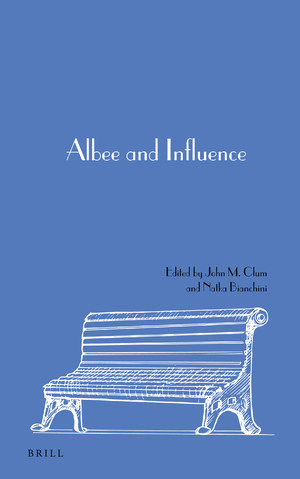
Brill has published the fourth volume of “New Perspectives in Edward Albee Studies,” Albee and Influence! Visit the Brill website for complete details.

The volume contains essays, written by leading Albee scholars, that focus on literary and philosophical influences on Edward Albee’s plays as well as essays on writers and works that Albee influenced. Essays focus on Albee’s relationship with such major American playwrights as Thornton Wilder, Amiri Baraka, Sam Shepard, Lanford Wilson and John Guare. There are also contributions on Albee’s work as mentor to young playwrights. The volume also includes an interview with award-winning director Pam McKinnon.

The table of contents includes:

“Introduction”
John M. Clum

“Part 1 Influences on Albee”
Editors: John M. Clum and Natka Bianchini

  • Chapter 1 “‘Lean[ing] against a Proscenium’: Edward Albee’s Me, Myself & I as Homage to Thornton Wilder”
    Author: Lincoln Konkle
  • Chapter 2 “‘The Opposition of Artworks to Domination Is Mimesis of Domination’: Albee via Adorno as a Conduit for Postmodern Playwriting”
    Author: David Marcia
  • Chapter 3 “Animal Sacrifice in Albee’s Plays and Its Influence on the Contemporary Stage”
    Author: Philipp Reisner

“Part 2 Albee’s Influence”
Editors: John M. Clum and Natka Bianchini

  • Chapter 4 “Love and Lies in the Living Room Dramas of John Guare, Tennessee Williams, and Edward Albee”
    Author: Michael Y. Bennett
  • Chapter 5 “Dramatic Dialogue: Amiri Baraka’s Response to Edward Albee’s Influence”
    Author: Douglas S. Kern
  • Chapter 6 “‘To Fail … and to Fail Interestingly’: Edward Albee, Sam Shepard and The Playwrights Unit”
    Author: Shannon Blake Skelton
  • Chapter 7 “Self-Constructed Dramatists: Edward Albee and Lanford Wilson as Outsider Playwrights”
    Author: David A. Crespy
  • Chapter 8 “Resistant Influencer: Edward Albee and Queer Plays of the 1960s”
    Author: Lesley Broder
  • Chapter 9 “‘Laughter and Pain’: Edward Albee and Nicky Silver”
    Author: John M. Clum

“Part 3 Interviews”
Editors: John M. Clum and Natka Bianchini

  • Chapter 10 “Interview: Director Pam MacKinnon on Finding the Artistic ‘Spine’ of Her Career and Working with Albee”
    Author: Natka Bianchini

Thanks to our series editor, Michael Y. Bennett, and our associate editor, Maija Birenbaum!

For more information about “New Perspectives in Edward Albee Studies,” visit our Book Series page.

 Albee and Influence Cover

The cover for Albee and Influence (Photo by Brill)

Back to News

Brill Backlist Book Sale

New Perspectives in Edward Albee Studies CoverAdd back volumes of New Perspectives in Edward Albee Studies or other Brill titles to your library: During the Brill Backlist Book Sale you may purchase all backlist titles at 40% off the list price. The sale runs until 31 December 2020. Just reference offer code 71276 with your order. For more details and to browse titles, please visit the Brill website.

Published by Brill, New Perspectives in Edward Albee Studies—a publication of The Edward Albee Society—is a book series that provides an outlet for scholarship and criticism on, or related to, Edward Albee and his works. Annual volumes feature original, academic essays, review-essays, and occasional interviews centered on a special topic. Each volume is edited by a different Editor. The book series welcomes and encourages different critical and theoretical scholarly approaches to Albee studies. In keeping with Albee’s own view that drama is literature, New Perspectives in Edward Albee Studies is also very interested in essays that examine Albee’s plays as dramatic literature.

For more information about New Perspectives in Edward Albee Studies, please visit our Book Series page.

Back to News

Call for Submissions: Edward Albee Abroad

Call for Submissions for Volume Five of New Perspectives in Edward Albee Studies, the Official Publication of the Edward Albee Society. Published annually by Brill.

(Volume One, Edward Albee and Absurdism, published January 2017, Volume Two, Sex, Gender, and Sexualities in Edward Albee’s Plays, published March 2018, Volume Three, Edward Albee as a Theatrical and Dramatic Innovator, published May 2019, Volume Four, Edward Albee: Influences and Influencer forthcoming, early 2021.)

Topic: Edward Albee Abroad

We are seeking essays that explore Albee’s work, influence, and reach abroad (i.e., outside of the American theatre). We encourage submissions from graduate students as well as established scholars or theatre professionals from any approach (e.g., theatre history, performance studies, literary theory and criticism), as well as those who have worked with Mr. Albee in any of the above activities.

Please contact both the Series Editor, Michael Y. Bennett (email: bennettm@uww.edu), and Volume #5 co-Editors, Esther Marinho Santana (email: esther.mrst@gmail.com) and Valentine Vasak (email: valentine.vasak@gmail.com). For submission guidelines, please see the general call for submissions on the Edward Albee Society website:

http://edwardalbeesociety.org/new-perspectives-in-edward-albee-studies-a-book-series/call-for-submissions/

Deadline of submission for completed manuscripts: January 31st, 2021.

Back to News

Volume 3 of “New Perspectives in Edward Albee Studies” Published

Brill has published the third volume of “New Perspectives in Edward Albee Studies,” Edward Albee as Theatrical and Dramatic Innovator! Visit the Brill website for complete details.

The publication offers eight essays and a major interview by important scholars in the field that explore this three-time Pulitzer prize-winning playwright’s innovations as a dramatist and theatrical artist. They consider not only Albee’s award-winning plays and his contributions to the evolution of modern American drama, but also his important influence to the American theatre as a whole, his connections to art and music, and his international influence in Spanish and Russian theatre.

The table of contents includes:

“Editors’ Introduction”
David A. Crespy and Lincoln Konkle

“Designing Edward/Edward Designing: A Brief History of Edward Albee’s Role in Theatrical Design”
David A. Crespy

“Theatrical Thanatology: Direct Address, Gestural Storytelling, and the Triple Goddess in Three Plays about Dying by Edward Albee”
Milbre Burch

“The Glee of Vulnerability: Becoming Kin with Edward Albee’s Goat”
Parisa Shams

“A Queer Reading of Love in Edward Albee’s Counting the Ways
Ashley Raven

“Albee Stages Secular Epiphany”
Nathan Hedman

“Art Is a Hammer: Aura, Textual Awareness, and Comedy in Albee”
David Marcia

“Affecting the Lives of ‘Others’: The Journey of Albee’s Plays in the Soviet Union”
Julia Listengarten

“The (Mis)Representation of Edward Albee in Spain, 1963–2010”
Ramón Espejo Romero

“Inside the Black Box: Albee’s Visual Aesthetics of Obscurity”
Valentine Vasak

“‘I Trap People’: An Interview with Edward Albee”
Jackson R. Bryer

Thanks to our series editor, Michael Y. Bennett, and our associate editor, Maija Birenbaum!

For more information about “New Perspectives in Edward Albee Studies,” visit our Book Series page.

 Edward Albee as Theatrical and Dramatic Innovator Cover

The cover for Edward Albee as Theatrical and Dramatic Innovator (Photo by Brill)

Back to News